Games in this collection
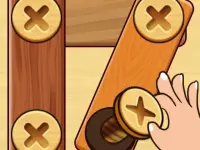
Wood Nuts Bolts Screw focuses on transferring hardware so wooden pieces can fall away. Screw Nuts Bolts: Wood Solve uses a closely related release idea, while Bolts and Nuts in 3D emphasizes spatial viewing. Nuts and Bolts Sort shifts attention toward grouping, and Wood Screw presents its own arrangement of screw-and-board problems. These games share a workshop theme but should not be treated as identical levels with identical rules.
What to observe
Check whether empty holes act as temporary storage, whether pieces move under gravity, and whether a board can rotate after one side is released. Count free spaces before moving. A screw that can be selected is not automatically the right screw: its board also needs a clear path. Work from visible overlap relationships and pause after animations reveal the new structure.
Practical strategy
Preserve one flexible hole whenever possible. Free exposed pieces to create more room, then reuse that room for deeper screws. When a level blocks, identify the first transfer that filled your last useful space and change only that part of the sequence. Calm single taps are more informative than several rapid inputs.
Players who want a detailed dependency method can use the internal Wood Nuts & Bolts guide. It explains scanning layers, choosing safe openings, and recovering from a crowded board.
Who may enjoy these games
This tag suits players who like untangling, visible cause and effect, and short puzzles that reward observation. Some entries feel methodical, while others add a timer or more dramatic physics. Read each game's opening prompt, start with a small controlled move, and let the particular rule set determine the solution.
Questions
Do all games use spare holes? No. Some do, while sorting or 3D variants use different controls. Is speed the main skill? Usually planning and accurate selection matter more. What creates progress? Releasing a piece or consolidating hardware so the remaining structure has more room.
Reading difficulty across titles
A simple board has a few visible overlaps and several spare positions. A harder one hides screw relationships behind large plates, limits storage, or uses shapes that catch as they fall. Difficulty therefore comes from dependency and space, not just the number of screws. If a title adds colored hardware, determine whether colors identify destinations, groups, or only decoration.
In 3D variants, rotate the view when the interface permits and inspect the rear connection before committing. In sorting variants, keep similar bolts together only when the receiving area has enough room for the remaining group. These are different tasks from dropping wooden plates, although both reward looking ahead.
A sensible first minute
Use the opening minute to test one control and observe one physical result. Confirm whether selecting a screw removes it, transfers it, or waits for a destination. Then locate the most exposed piece and the available workspace. This prevents assumptions carried over from another game in the tag.
If a level includes limited retries or hints, reserve them for a position you have already analyzed. A hint is more useful when you can compare its suggested move with your own plan. The collection is most satisfying when each correction improves your understanding of the structure rather than producing a lucky sequence.
For the clearest learning path, begin with a board whose screws and holes remain visible, then move to dense or three-dimensional layouts. Increasing one source of complexity at a time makes it easier to recognize whether a failure came from the rule, the viewing angle, or the move order.