


















uno scuffed The Ultimate 2025 Player’s Guide to Chaotic Card Mastery
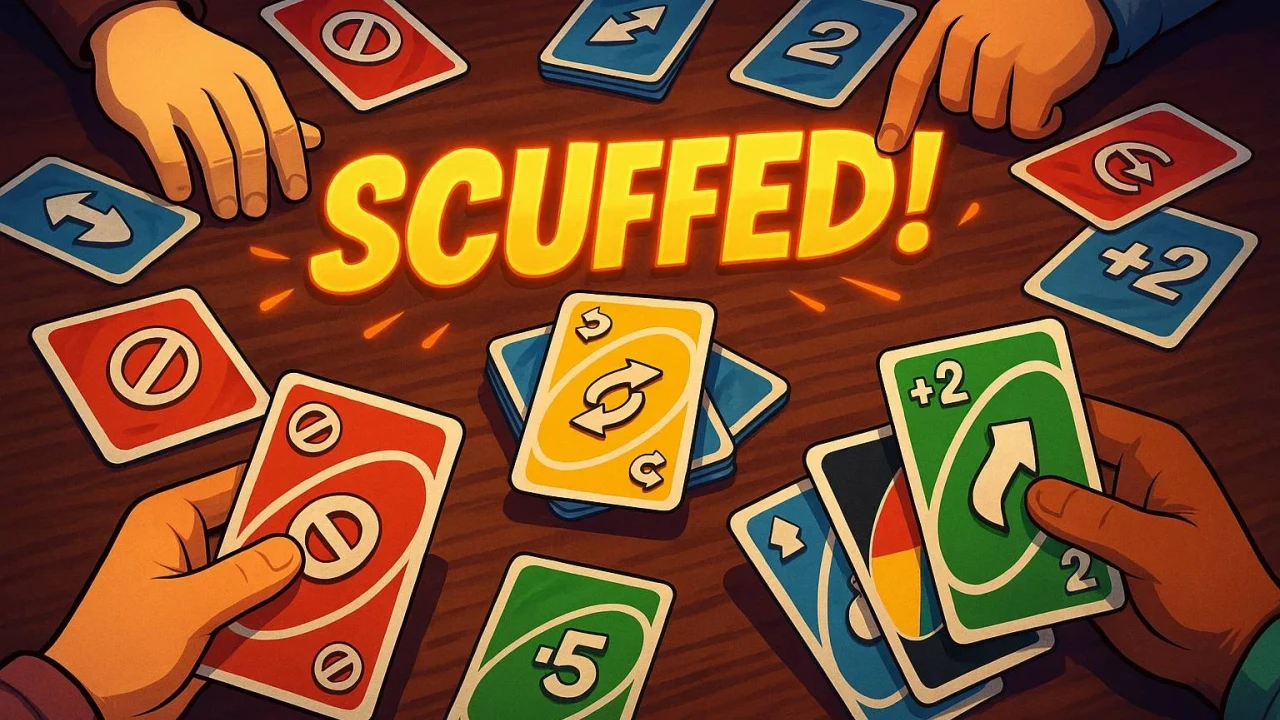
If classic party card games are polite conversation, uno scuffed is the friend who kicks the door in with sunglasses and a fog machine. It keeps the color-and-number matching you already know, then adds turbo-charged twists stacks, chains, reversals that boomerang, hand swaps that flip the scoreboard, and momentum swings that turn “I’m about to win” into “Why do I have 22 cards?” In this guide, you’ll learn the core loop, house-rule variants, ruthless strategies, psychology, and etiquette so you can dominate lobbies without becoming that player.
Whether you’re warming up for a quick match or grinding ranked rooms all evening, this is your blueprint.
What Is uno scuffed (in one minute)?
At its heart, uno scuffed is a rules-flexible, high-chaos version of a color/number matching card game. You aim to empty your hand first by playing a card that matches the top of the discard pile in color or number/symbol. Wilds change the color; action cards warp tempo by forcing draws, skipping turns, reversing play direction, or swapping hands.
What makes uno scuffed different is how liberally it embraces stacking and chaining. Instead of stopping at a single Draw 2 or Skip, you can often pile cards of the same action or compatible value, pass punishment to the next player, and trigger combos that erase entire hands or refill yours in seconds. In short: it’s still familiar but feral.
Why Players Love It
-
Short rounds, big drama: Every two minutes there’s a swingy moment people will talk about all week.
-
Skill expression inside chaos: Reads, memory, tempo control, and hand sculpting matter more than you think.
-
Content-ready: Perfect for streams and clips salty reversals, improbable escapes, and 0-to-victory comebacks.
Play Now
Ready to jump in? Start a lobby of uno scuffed here: Play Scuffed UNO.
The Core Loop (Fast Refresher)
-
Match the top card by color or number/symbol.
-
Use action cards to control tempo (Skip, Reverse, Draw chains, Wilds).
-
Announce when you’re at one card (or suffer a penalty, depending on rules).
-
Sculpt your hand so your last 2–3 cards are easy to dump under multiple colors.
-
Finish by sequencing out with minimal informational leakage.
That sounds simple until stacks and chains arrive.
Stacks, Chains, and the “Scuffed” Twist
While exact rule sets vary by lobby, these are the most common uno scuffed modifiers and how to abuse them:
-
Stacking Draws: Draw 2 can be stacked on Draw 2; Draw 4 can stack on Draw 4. The total passes to the next player who can’t stack.
-
Strategy: Keep at least one stackable punishment in hand as insurance. If you sense your left neighbor is weak, dump the stack before they top-deck.
-
-
Action Matching: You can respond to a Skip with another Skip, even off-color, to hop across multiple players.
-
Strategy: In 4+ player lobbies, double-skip to cycle past opponents who track your hand too well.
-
-
Seven-Zero or Swap Rules: A 7 lets you swap hands with any player; a 0 rotates all hands in play direction.
-
Strategy: Track “fat” hands (lots of action cards). Intentionally bloat yourself temporarily so a forced swap gives you ammo later.
-
-
Jump-Ins: If you have exactly the same card as the top discard (same color and value), you may slam it out of turn.
-
Strategy: When two players are low, hover a duplicate to interrupt their win line.
-
-
Wild on Wild: Some rooms allow a Wild to follow any Wild, freely changing color.
-
Strategy: Chain Wilds to burn opponents’ color calls and land on your strongest palette.
-
-
Draw-on-Uno Penalties: Failing to declare “uno” (or equivalent button) forces a penalty draw.
-
Strategy: If you play to one card, wait half a beat to bait a callout then hit the button.
-
Hand Crafting 101: Build a Closing Hand
The best players plan their last three cards as early as turn two. Here’s the shape you want:
-
One Flexible Closer: A Wild or number that appears in two colors you’re already holding.
-
One Color Bridge: A mid-value number in a different color that can transition into your closer.
-
One Escape Valve: A Skip/Reverse/Draw or duplicate number to dodge a color lock at the end.
Example endgame map:
[Yellow 7] → [Yellow Skip] → [Wild (+ chosen color)] → GG
This path closes while dodging intervening turns, and the Wild grants emergency flexibility.
Tempo Control: When to Attack vs. When to Tuck
-
Attacking (Snowball Mode):
Use stacks and jumps when your left neighbor is low or color-locked. Your goal: create dead turns where multiple players cannot respond, pushing rotation back to you quickly. -
Tucking (Survival Mode):
If you’re color-starved or sitting next to a stacker, dump information-light cards: duplicate numbers, off-color matches, and mid-value fillers. Save your Wilds and Skips until you’ve repaired your palette.
Rule of Thumb: Attack when you control color or have a protected closer. Tuck when your hand has holes.
Reading the Table (Yes, You Can “Count Cards” Here)
You don’t need a photographic memory just track categories:
-
Left Neighbor: Do they keep passing? They’re likely off-color; call that color again.
-
Right Neighbor: Are they hoarding action cards? Expect a Reverse/Skip; keep a counter-skip ready.
-
Across the Table: Player hovers on one card after a color change? They probably lack that color; freeze it.
Micro-tells:
-
Quick play on color match = strong palette.
-
Hesitation on number match = limited palette, relying on symbol.
-
Rapid Wild after drawing = they were locked; their declared color is likely their weakest (bait).
Advanced Plays That Win Lobbies
-
Color Poisoning
Intentionally play numbers that appear only in colors your neighbors dislike. This shrinks their match space and forces them to draw, revealing weakness. -
Shielded Uno
Go to one card by playing Skip or Reverse so the next player never gets a chance to punish you. Works best in rooms honoring Skip chains. -
Baited Swap
In Seven-Zero rooms, hold a 7 while bloating your hand with Draw 2s. When a rival nears victory, swap to take their three-card hand and leave them the punishment package. -
Silent Bridge
Keep two identical numbers in different colors; late game, you can bridge any forced color with minimal information. -
Sacrifice Turn for Intel
Sometimes drawing intentionally reveals less than a forced Wild color call. Take the draw to avoid telegraphing your palette.
Multiplayer Etiquette (Win Without Becoming the Villain)
-
Stack within reason: Chain punishments are the point, but 30-card avalanches every round kill fun.
-
No slow-rolls: If you’ve got the closer, play it.
-
Acknowledge hero plays: A heartfelt “nice jump-in” smooths salt and keeps lobbies lively.
35 Quick Tips (Copy/Paste Checklist)
-
Plan your last three cards from turn two.
-
Keep one Wild until the final rotation.
-
Draw 2s are insurance don’t dump them all early.
-
Reverse is a weapon when the right neighbor is weak.
-
Skip + Skip chains delete turns; set these up midgame.
-
Seven-Zero: track who’s hoarding action cards.
-
Jump-in duplicates are worth more than random fillers.
-
If two players are at one card, freeze the color, not the number.
-
Declare uno instantly; bait callouts for free draws then hit the button.
-
When color-locked, draw once; if it bricks, Wild proactively.
-
Never reveal your best color unless forced.
-
Use mid-value numbers to bleed information slowly.
-
Passing on a playable card can be correct if it hides your palette.
-
Reverse into a known stacker to boomerang their punishment.
-
Keep track of who drew 4+ recently they probably lack the current color.
-
Play duplicates back-to-back to reduce tells.
-
Use Wild-to-number, not Wild-to-Wild; double Wild screams desperation.
-
Against a one-card opponent, prefer action over number plays.
-
If you can’t win this rotation, deny the leader the color they want.
-
Save a bridge in a third color for late flips.
-
Pair Skip with an immediate color change to strand opponents.
-
Don’t swap hands blindly count action density first.
-
Stack small now to avoid eating a massive stack later.
-
When behind, create chaos: Wild shifts, jumps, and swaps.
-
When ahead, simplify: numbers and gentle color holds.
-
Announce only once; spam invites penalties (in some rooms).
-
Watch cursor tremors/hovers people betray their intended colors.
-
Top-deck draws often signal off-color; press that color again.
-
Play to the player, not the deck: punish known risk-takers.
-
In 2-player duels, track exact colors for perfect locks.
-
Use zeros (rotate) right after you stockpiled utility.
-
Keep one low-information card for emergency passes.
-
Ending on Draw cards is safer than ending on numbers.
-
If your closer is fragile, set up Shielded Uno (Skip/Reverse).
-
Enjoy the chaos calm minds win scuffed rooms.
Common Mistakes (and Fast Fixes)
-
Mistake: Burning Wilds early “for tempo.”
Fix: Hold at least one Wild until you can force your closer’s color. -
Mistake: Showing your strongest color midgame.
Fix: Play middle numbers in secondary colors; save your best palette for last. -
Mistake: Stacking blindly into a player who hoards Draws.
Fix: Test with a small stack first; observe if they bounce it back. -
Mistake: Ending with a single color.
Fix: Keep a two-color bridge so any forced color change still lets you dump. -
Mistake: Swapping hands without counting action density.
Fix: Choose targets whose small hands showed numbers, not utility.
Streamer & Creator Playbook 🎬
uno scuffed is content gold. To maximize watch time:
-
On-screen primers: Show a tiny “house rules active” HUD (Stacking, Jump-Ins, Seven-Zero).
-
Clip moments: “40-card revenge stack,” “seven brain swap,” “double jump-in save.”
-
Teach while you play: Call your reads (“left is off blue; keep blue”) to turn chaos into lessons.
FAQ Detailed Q&A About uno scuffed
1) What exactly is “uno scuffed ”?
A fast, house-rule-heavy version of a color/number matching card game where stacking, jump-ins, and hand swaps create wild momentum swings. The goal is still to empty your hand first, but the routes are delightfully messy.
2) Does skill really matter in such a chaotic game?
Yes. You can’t control the draw, but you can control information leakage, tempo, and endgame planning. Strong players consistently sculpt closers and punish color locks.
3) What’s the best opening play?
A low-information number that preserves your Wilds and action cards. You’re building flexibility, not broadcasting your palette.
4) Should I ever draw on purpose when I have a match?
Sometimes. If playing would reveal your anchor color (or invite a stack war you’ll lose), taking a single draw can be safer.
5) How do I handle Seven-Zero rooms?
Count action density. If a rival is obviously hoarding Skips/Draws, keep your hand small and surgical then 7-swap at the last rotation to steal their kit.
6) Is it better to end on a number or an action?
An action closer (Skip/Reverse/Draw) is safer because it denies immediate counterplay. Ending on a naked number is easier to disrupt.
7) What’s the counter to a notorious stacker?
Reverse to boomerang their punishment, hoard one stackable response, and freeze their favorite color. Force them to top-deck instead of enabling chains.
8) When should I change color with a Wild?
Either to enable your two-card finish or to lock the leader. Random color swaps midgame leak that you’re weak.
9) How do I stop a player on one card?
Prioritize action cards and forced color changes. If jump-ins are allowed, hover duplicates to interrupt the finish.
10) Any quick mindset for winning more?
Think three turns ahead: What color gets played after mine, and what do they want? If you deny that path while building your closer, you’ll win far more lobbies.
Final Word
The joy of uno scuffed is riding the line between chaos and control. Plan your final three cards, protect one Wild, read the table for color weaknesses, and unleash stacks only when they win a rotation not just for spectacle. Do that, and you’ll turn lobbies full of lucky breaks into highlight reels where you write the script.