


















scuffed uno — The complete, no-fluff guide to chaotic card battles
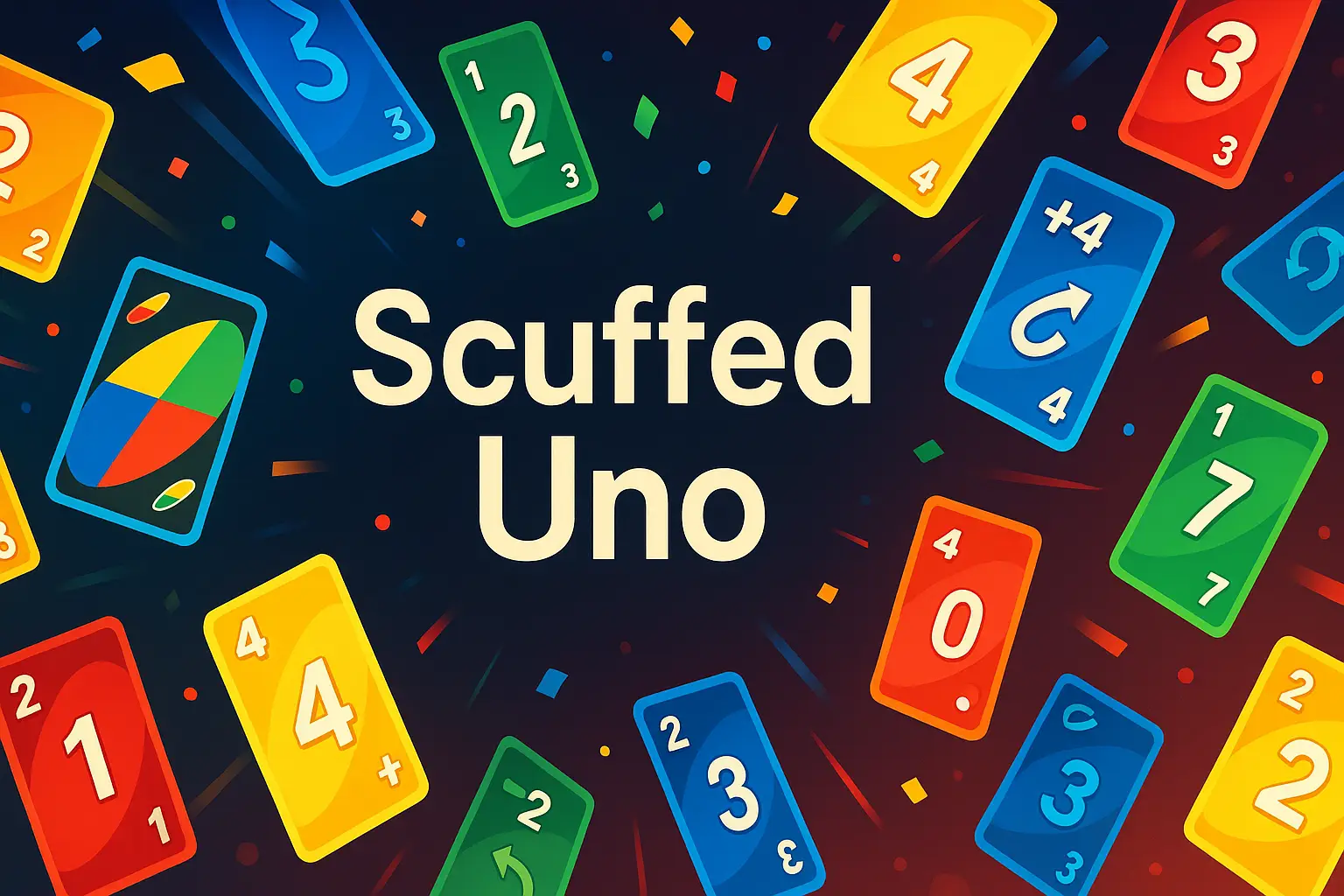
If you love the classic UNO format but want a wilder, louder, faster game night, scuffed uno is your jam. Think of it as “UNO with turbo boosters”—the same easy-to-learn color/number matching core, but layered with community-favorite house rules that chain effects, swap hands, and push players into deliciously messy situations. In this guide, you’ll learn exactly what scuffed uno is, how to set it up, the most popular variants, and the strategies that turn chaos into consistent wins. You’ll also get 10 detailed FAQ answers so you can settle table disputes before they blow up your group chat.
Quick note: scuffed uno isn’t an official edition—it’s the internet’s nickname for UNO played with stacked house rules. For the base game’s history and fundamentals, see the entry for Uno (card game) on Wikipedia.
What is scuffed uno?
scuffed uno is a community-driven way to play UNO that embraces “anything goes” house rules. Instead of sticking to the standard, you combine popular variants such as stacking +2s and +4s, swapping hands when a 7 is played, jumping in out of turn with a perfect match, forcing wild calls to be honest, and more. The result is a game that:
-
Escalates quickly (one misplay can snowball into a 10-card draw).
-
Rewards table awareness (tracking colors and opponents’ hand sizes matters).
-
Creates memorable moments (hand-swaps, chain reactions, and dramatic top-decks).
You can play scuffed uno with any standard UNO deck. Before starting, align on which house rules your table wants to use (grab the lists below), and write them down to avoid mid-game arguments.
Dive into ScuffedUno — The Ultimate 2025 Guide to Chaotic Card Battles, House Rules & Browser Strategy, covering core rules, brutal +2/+4 stacks, 7–0 swaps, and trolling combos to dominate lobbies. Get unblocked-play tips, quick friend-lobby setup, and smart hand management to force wild turns, clutch reverses, and game-winning topdecks.
How to set up scuffed uno
-
Players: 2–10 (sweet spot: 3–6 for peak chaos without slowing down).
-
Deck: 1 standard UNO deck for up to ~6 players; consider 2 decks for bigger groups.
-
Deal: 7 cards each. Place the rest face-down as the draw pile. Flip the top card to start the discard pile. If the starter is a wild, the dealer picks a color.
Before you start the first round, agree on:
-
Which stacking rules are in play.
-
Whether jump-in is allowed.
-
If 7-0 (swap hands / rotate hands) is enabled.
-
Whether you can end on an action card.
-
How to handle challenge calls on Wild Draw Four.
Core rules recap (the foundation)
-
On your turn, play one card that matches the discard pile’s color, number, or symbol—or play a wild.
-
If you can’t play, draw one card; if it’s playable and your table allows “draw-to-match,” you may immediately play it (decide this in advance).
-
When you’re down to your last card, you must say “UNO” before your turn ends. If an opponent catches you before the next player draws or plays, you draw two cards.
-
Round ends when a player sheds all cards. Score (optional) by adding up values of opponents’ remaining cards.
These basics stay intact in scuffed uno—what changes are the house rules below.
Popular scuffed uno house rules (pick your chaos level)
Mix and match. More rules = more unpredictability.
1) Stacking Draw Twos (+2 on +2)
If someone plays a +2, the next player can respond with another +2 to pass the penalty forward. It keeps stacking until a player can’t stack, and they draw the sum.
Why it’s great: Snowballs tension, rewards saving +2s.
What to clarify: Can a Reverse or Skip dodge a +2 chain? Decide up front.
2) Stacking Wild Draw Fours (+4 on +4)
Same concept as +2 stacking. A +4 can be stacked with another +4, passing a massive draw to the next player who can’t stack.
Risk/Reward: Holding a +4 to stack later can swing entire rounds.
Clarify: Some tables ban +4 stacks because they’re brutal. Align early.
3) Mixed stacking (+2 on +4 and vice versa)
Ultra-chaotic mode: +2 and +4 stack interchangeably. A +2 can be slammed on a +4 chain and the other way around.
Caution: Extremely punishing. Fun in party settings; less fun for casual players.
4) Jump-In
If you have the exact same card (same color and number/symbol) as the one on top of the discard pile, you can immediately play it, even if it’s not your turn. Play continues from you.
Skills rewarded: Fast reactions, hand awareness.
Clarify: Does jump-in interrupt draw penalties? Decide beforehand.
5) The 7-0 rule
-
Play a 7: You swap hands with any player of your choice.
-
Play a 0: All players rotate hands in the direction of play.
Meta impact: Hand management matters more than raw card count.
6) Force-Play on Draw
If you draw a playable card on your turn, you must play it.
Why it matters: Removes “sandbagging” and speeds up rounds.
7) End-on-Action allowed
Permits ending the game by playing a Skip, Reverse, +2, or +4.
Hot tip: Ending on Wild Draw Four can be controversial. Decide if it’s allowed.
8) Honest Wild Draw Four
A player may only use Wild Draw Four if they don’t have a card matching the current color. If challenged and found lying, they draw instead.
Variation: Challenger draws 6 on a failed challenge—spicy!
9) Chain reactions from Skips & Reverses
Some groups allow multiple Skips or Reverses in a row to compound effects (e.g., double-skipping or “ping-ponging” direction twice to attack a specific player).
10) Draw-’til-you-play
Extreme version of draw rules: if you can’t play, draw until you find a playable card.
Note: Adds variance; better for short, high-energy sessions.
How to play scuffed uno (step-by-step)
-
Deal & disclose your house rules in writing (yes, literally write them).
-
Start the discard with the flipped card’s implications (if it’s +2, apply it, etc., based on your rules).
-
Play clockwise, matching color/number/symbol or using wilds. Apply house rules like stacking or jump-in immediately when triggered.
-
Call out UNO at one card. Enforce penalties fairly and consistently.
-
End of round: The winner is the first to empty their hand. Optionally tally points for a multi-round match (e.g., first to 500).
Strategy: how to win scuffed uno consistently
1) Manage colors like a conductor
-
Consolidate your hand to 2–3 dominant colors early.
-
Use wilds to pivot the table to your strongest color.
-
When opponents are low on cards, flip to a color you suspect they lack.
2) Time your action cards
-
Reverse can function as a soft defense if the player behind you hoards draw cards.
-
A well-timed Skip denies an opponent with one card the chance to go out.
-
+2/+4 should be held when possible to stack or counter-attack in house-rule games.
3) Track hands (lightweight counting)
You don’t need hard counting—just notice:
-
Who just drew a lot.
-
Who hasn’t played in a while.
-
Who jumped in (implies duplicates) and who chooses colors (implies color strength).
4) Play the table, not just the cards
scuffed uno is social. Bluffing about color strength, baiting challenges on Wild Draw Four, or nudging the table toward enabling your teammate (in team variants) are all part of the meta.
5) Protect your endgame
-
Keep at least one Wild or color-switch for your last two cards.
-
Avoid telegraphing your final color; vary your plays.
-
If 7-0 is on, don’t reveal your power card count—someone might swap with you.
6) Respect jump-in tempo
When jump-in is enabled, duplicates are king. Consider not playing your only copy of a number/color if you suspect someone can jump in and flip tempo against you.
Etiquette & rule negotiation (staying friends after the game)
-
Write rules down before hand one. Sticky notes save friendships.
-
Majority rules, but put veto power on wildly punishing combos (e.g., mixed +2/+4 stacks).
-
No slow-rolling: act promptly, especially if jump-in is allowed.
-
Be consistent with penalties; if you call missed “UNO” once, call it every time.
Fun ways to use scuffed uno in groups
-
Party mode: Enable 7-0, jump-in, and mixed stacking. Keep rounds short (first to 200 points).
-
Streamer challenge: Chat votes on a new house rule every 3 rounds.
-
Classroom/Team warm-up: Use a limited scuffed set (e.g., only jump-in and 7-0) to energize without overwhelming.
Digital and travel-friendly play
You can bring scuffed uno vibes anywhere:
-
On the go: Carry a deck in a zipper pouch.
-
Hybrid play: For video calls, one person runs the discard/draw camera; players hold hands off-screen. Use a shared doc to keep the house-rule list visible.
-
Online tools: Many digital card platforms mimic UNO. To get the scuffed feel, create custom lobbies and toggle variants that mirror your favorite rules.
Want to try scuffed uno right now?
You can jump straight into a fast, browser-friendly version. Play scuffed uno here: https://www.kizi10.org/game/scuffed-uno
(Link included once, as requested.)
FAQ: 10 detailed questions about scuffed uno
1) What makes scuffed uno different from standard play?
scuffed uno isn’t an official mode; it’s a bundle of house rules the community loves—stacking penalties, jump-ins, and hand swaps. The core objective remains the same, but the flow is far more volatile, with more swing turns and multi-card penalties. If your group loves dramatic turnarounds and table talk, scuffed uno delivers.
2) Should we allow stacking +2 and +4 together?
Only if your group enjoys maximum chaos. Mixed stacking lets +2 and +4 interlock, making penalties skyrocket. It’s great for party energy but can feel oppressive for newer players. Compromise by allowing +2 on +2 and +4 on +4, but not cross-stacking.
3) Is jump-in fair, or does it advantage faster players?
Jump-in rewards situational awareness and duplicate management. Faster reflexes help, but the real edge is anticipation—saving duplicates and reading the discard flow. If physical speed is an issue, add a 1-second count-in (“3…2…1…go”) after a card hits the pile before anyone can jump.
4) How do we handle challenges on Wild Draw Four?
Use the honesty rule: you can only play Wild Draw Four when you cannot match the current color. If challenged and guilty, you draw instead of your target. Decide the penalty size up front (standard is 4 to the liar; some tables award 6 to the failed challenger to discourage spam-challenges).
5) Can you end a round on an action card in scuffed uno?
It’s up to your table. Allowing “end-on-action” lets players finish with Skip, Reverse, +2, or even +4 (if permitted). If your group hates abrupt endings off penalties, ban ending on +2/+4 but allow Skip/Reverse.
6) What’s the best number of players for scuffed uno?
3–6 hits the sweet spot. With fewer than 3, variance is low and chains are rare. With more than 6, turns stretch and the draw pile can drain quickly (use two decks for 7+).
7) Is there a balanced scuffed ruleset for mixed-skill groups?
Try this balanced bundle:
-
Stacking allowed: +2 on +2, +4 on +4 (no cross-stacking).
-
Jump-in enabled.
-
7-0 rule enabled.
-
Force-play on draw (keeps tempo high).
-
No ending on +2/+4.
This mix preserves big moments without turning every turn into a penalty chain.
8) How do scoring and match play work with scuffed uno?
Use standard point values, but set a lower match target (e.g., 300–400 points) because scuffed rounds can be swingy and longer. Alternatively, first to 5 round wins is clean and party-friendly. If 7-0 is on, expect more variance—shorter matches feel better.
9) What are advanced tips for consistent wins?
-
Color funneling: steer the table toward colors you hold in bulk using Reverses/Wilds.
-
Power-card concealment: don’t play all your action cards early; save at least one for endgame defense.
-
Positioning: in 4+ players, sitting after the “draw bully” can be good if you hold Reverses to deflect.
-
Tempo traps: when jump-in is live, avoid playing lone numbers/colors that likely give free turns to opponents with duplicates.
10) How do we avoid arguments mid-game?
-
Codify rules in a note before starting.
-
Use a “table captain” for weird edge cases, rotating each round.
-
For ambiguous interactions (e.g., “does a jump-in cancel a pending +2 chain?”), decide once, write it down, and apply it consistently for the whole session.
Common edge cases (decide these before you deal)
-
Jump-in vs. draw penalty: If a player jumps in during a +2 chain, does the chain pass to the next player or reset?
-
Reverse during a penalty: Does Reverse change who takes the pending draw?
-
Multiple action endings: If a player ends on Reverse, who starts the next round? (Tip: direction carries over; the next player in the new direction deals first.)
Document your answers on a sticky note or in your phone’s notes. That tiny ritual saves ten minutes of debate every round.
House-rule presets you can copy
Party Chaos (high energy)
-
Mixed stacking (+2/+4), jump-in, 7-0, end-on-action allowed, draw-’til-you-play.
Expect: Big laughter, bigger draw piles.
Competitive Scuffed (balanced)
-
+2 on +2, +4 on +4 (no mixing), jump-in, 7-0, force-play on draw, no ending on +2/+4.
Expect: Decisions matter; fewer “feel-bad” chains.
Family-Friendly (teachable)
-
No stacking, jump-in off, 7-0 on, standard draw-one house rule, end-on-action off.
Expect: Cleaner pacing for kids and new players.
Final tips for unforgettable scuffed uno nights
-
Talk through the first two weird interactions out loud, so everyone learns the flow.
-
Shuffle more than you think—action clumps can skew games.
-
Mind sportsmanship: calling missed “UNO” is part of the game; be consistent and good-natured.
-
Rotate house rules every 3–5 rounds to keep the format fresh.
-
Celebrate reversals—they’re what make scuffed uno legendary.
Whether you’re here for pure party chaos or a sharper, strategy-forward variant, scuffed uno gives you the freedom to tune the experience to your table. Nail down your rule set, play with conviction, and enjoy the kind of table talk and turnarounds only this wonderfully “scuffed” format can produce.
Dive into ScuffedUNO: Chaotic Card Battles 2025
Shuffle, slam, and sabotage in ScuffedUNO, a gloriously unhinged twist on classic card play. Stack wild
effects, reverse momentum with brutal skips, and force hilarious rage-draws. It’s easy to learn, vicious
to master, and perfect for voice-chat chaos. For strategies, deck synergies, and ruthless house rules,
study the 2025 meta guide at
ScuffedUNO – The Ultimate 2025 Guide to Chaotic Card Battles.
Bring cunning bluffs, time your detonations, and become the lobby’s lovable villain.