
















Cut the Rope Guide: Candy Routes, Stars and Careful Cuts
A good Cut the Rope solution starts before the first rope is severed. Look at the candy, the places it can travel, and the hungry character waiting at the end of that route. Cutting removes a support, but it does not erase the motion the candy already has. A sweet that is swinging may continue sideways after release, while a sweet hanging still has a much more direct initial fall. Understanding that distinction turns repeated guessing into a puzzle you can investigate one decision at a time.
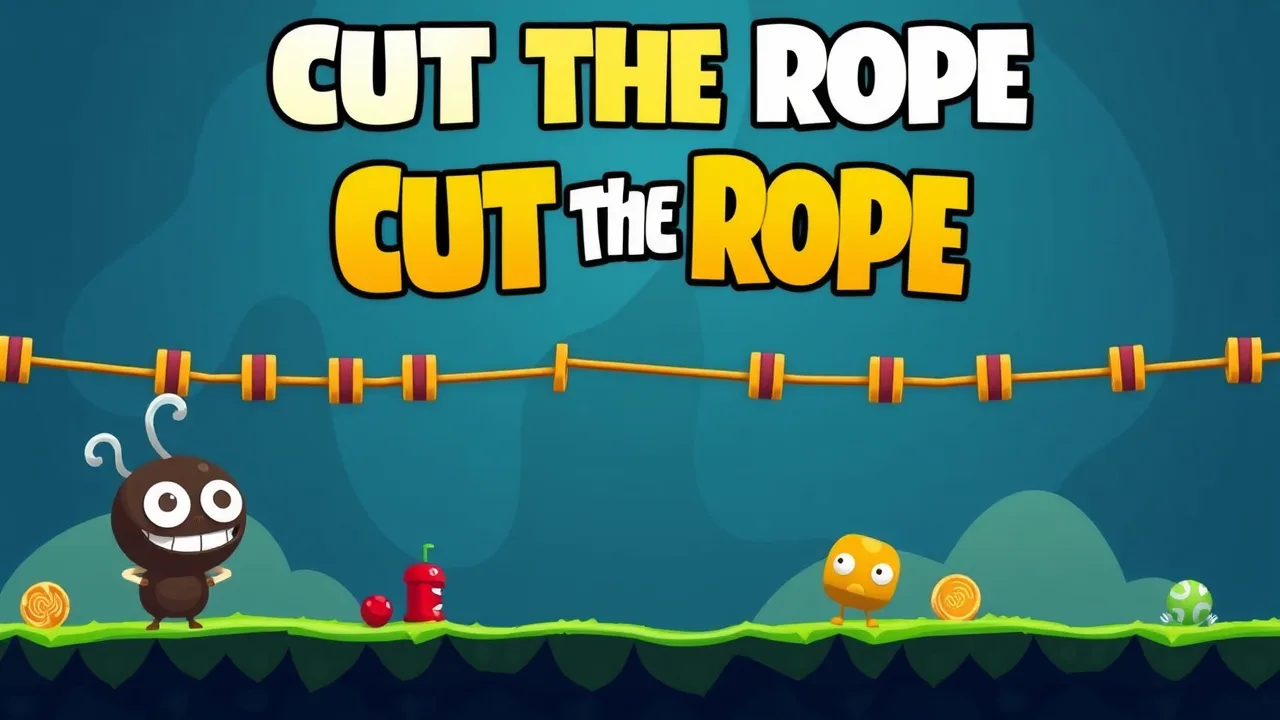
This guide follows the game currently loaded through the Cut The Rope 2 page on Kizi10. The page keeps that established name, but its embedded opening screen identifies the playable version as Cut the Rope: Time Travel. The verified first puzzle contains two candies, two hungry characters, and three collectible stars. Advice below reflects that observed version. It does not assume the level count, helpers, or extra modes of a different release, and it explains why feeding one character is only part of this opening challenge.
Read the destination before the rope
Begin with the receiving characters and work backwards. In the opening pirate scene, one candy hangs above each character, with stars along the downward routes. This makes the basic relationship visible: each suspended sweet needs to reach a mouth. Before touching a support, trace a plausible path from the candy to its destination. Check whether the candy is directly above the character or offset to one side. An offset does not automatically mean the puzzle is impossible; it tells you that direction and movement may matter more than a simple vertical release.
Next identify everything holding the sweet in place. A rope is a constraint on its movement, and removing one changes the forces acting on it. When a later arrangement has more than one support, think about the role of each before choosing an order. One might keep the candy at a useful height while another influences its sideways position. You do not need formal physics calculations. A practical question is enough: what will this particular candy still be attached to after the cut I am considering?
Make a clean cut and observe the whole result
In the verified opening, dragging across a rope with the mouse severs it and releases the attached candy. Draw across the support you intend to remove rather than making a large, uncontrolled sweep across the whole scene. A broad gesture can cross a second rope, making it difficult to separate an intended result from an accidental action. On a touch device, follow the current game's response to your gesture rather than assuming that a stationary tap and a swipe perform exactly the same action.
After a cut, let the motion develop long enough to understand it. Watch where the sweet passes, whether it touches a star, and where it finally goes. Making a second cut too soon can hide the information from the first one. If you are learning a new arrangement, observation is productive time. A failed route can still reveal whether the candy dropped too early, retained more sideways movement than expected, or passed the intended destination at the wrong height. Those are specific findings you can use on a replay.
Two characters mean two routes to check
The opening Time Travel scene pairs Om Nom with a pirate counterpart. Treat their candies as separate tasks that belong to the same puzzle. After feeding one character, locate the other candy and its remaining support instead of assuming that the level is already finished. The second route deserves the same attention as the first. This is a useful correction to general advice that describes every Cut the Rope puzzle as a single sweet falling into a single mouth: the visible objectives in this version require a broader check.
Separate tasks do not always mean that every future layout can be solved independently. If a scene contains objects that can affect more than one path, inspect those relationships before acting. The important habit is to account for both destinations. You can describe your plan in plain language: release this candy towards that character, preserve the other support until its route is ready, then complete the remaining feed. A verbal plan often exposes a missing step that is easy to overlook when your eyes are fixed on the first rope.
Use stars to refine a route
Stars are visible collectibles along the opening paths, with three empty star outlines shown in the level display before collection. They give you a reason to consider the candy's route as well as its final destination. First work out how to feed the characters reliably. Then examine where a successful route passes in relation to any missed star. This separates two useful questions: can the candy reach the mouth, and can you improve its journey? Trying to answer both at once can make the initial solution harder to understand.
When a star lies to one side of a hanging candy, consider whether a different release position or sequence would take the sweet through it. Do not assume that every missed star requires a faster gesture. It may instead require preserving a support for longer or releasing during a different part of a swing. Test the explanation that fits the movement you observed. Treat a star as a spatial clue to investigate, and check the actual result screen for what the game recorded rather than inventing a scoring rule.
Distinguish a hanging candy from a moving one
A sweet resting beneath its attachment point gives you a relatively simple first prediction. Once released, it begins falling from that position. A swinging sweet already has sideways movement, so severing the rope does not make it freeze and fall straight down. Watch at least enough of the swing to identify the direction of travel. Releasing while it moves towards the destination can produce a different path from releasing at a similar location while it moves away. Position alone does not fully describe the state of a moving puzzle.
The ends of a swing and its lower middle are useful visual references for experiments. At an end, the candy changes direction; around the lower part, its motion can be easier to see. These are observation points, not universal instructions to cut at one exact instant in every level. Choose a recognisable moment, try it, and compare the resulting path with your intended route. Keeping the reference consistent makes a replay informative. Changing both the cut order and the release moment at random makes it much harder to learn which choice mattered.
Replay with a single question
The visible level controls include a restart symbol, which is useful when you want to investigate an arrangement again. Before restarting, decide what the next attempt will test. Perhaps you want to cut a different support first, wait until the candy moves towards a character, or use a smaller swipe to avoid another rope. Hold other decisions steady where possible. If the next attempt improves, you then have a sensible explanation for that improvement instead of only a memory that something different happened.
A short note can help on a stubborn puzzle. Record the first support you removed and the direction the candy took, using simple descriptions rather than precise measurements. For example, note that it passed above the mouth or fell before reaching a star. These observations define the correction you need. A route that is already close may call for a timing adjustment, while a route heading away from both characters may require a different sequence. Restarting is most useful when it follows a clear diagnosis.
Keep the puzzle readable
Before a delicate gesture, make sure the rope you intend to cut is clearly visible in the play area. Avoid beginning a swipe on a nearby menu control, and check that the game responds before continuing with another action. If the animation stalls or the scene becomes difficult to read, pause your inputs rather than trying to compensate with several extra gestures. Additional cuts cannot repair missing information about where the candy is. Once the view is stable, resume from the state actually shown on the screen.
The wider Cut games collection contains other uses of cutting, from rope puzzles to fruit slicing. Those games can offer a change of pace, but their objectives are not interchangeable. Cutting a support changes a physical route; slicing a moving target asks you to place a gesture across the target itself. Return to this puzzle with that distinction in mind. Here, each rope is part of an arrangement whose consequences continue after your input, so the important work is predicting and then observing what your cut releases.
Before you leave a level
Check both characters, the remaining candy, and the star feedback rather than judging completion from one successful animation. If a route failed, name the cause you can actually see and choose one adjustment for the replay. If you completed the feed but missed a collectible, preserve the working parts of the solution while experimenting with the relevant path. This approach gives each attempt a purpose. The game's charm comes from a small gesture producing a lively chain of consequences; solving it becomes more satisfying when you can explain why that chain finally led the candy where you wanted.