

















Play scuffed uno Online – Tips, Tricks Strategy
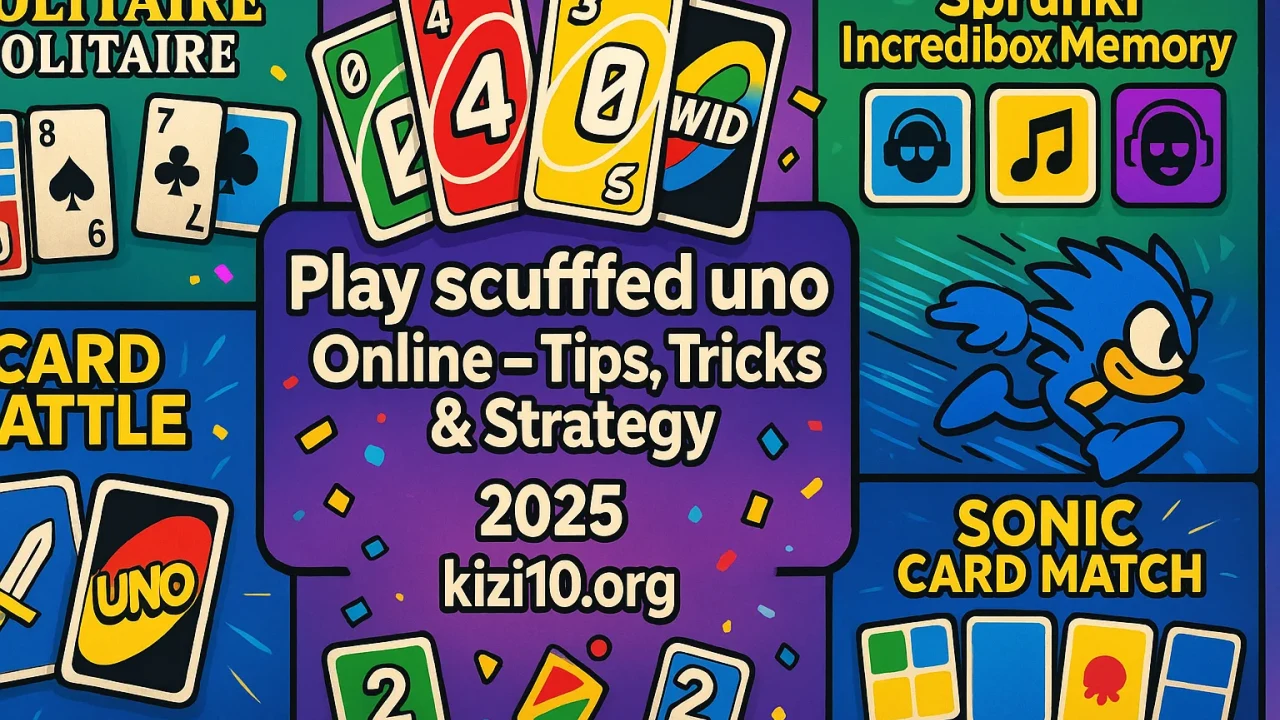
If you’re craving the chaotic, meme-tier cousin of classic UNO, you’re in the right place. scuffed uno takes the “draw, match, reverse the pain back to your friend” energy and cranks it to 11 with wild rules, unexpected combos, and zero chill. It’s the kind of browser game you open for “just one round” and then realize you’ve been stacking Draws like a villain for an hour. This guide gives you straight-talk strategy, zero fluff, and the exact moves that win matches consistently—whether you’re grinding solo or clowning your squad.
Play scuffed uno now on https://www.kizi10.org/.
We’ll cover how it works, the cleanest win conditions, the “don’t be that guy” mistakes, and the high-IQ plays that flip a losing hand into a checkmate. Stick around till the end for five hand-picked similar games on Kizi10—perfect when you want to cool down (or keep the card-game tilt going).
What is scuffed uno? 📖
At its core, scuffed uno is an online shedding-type card game inspired by the familiar UNO rules you grew up with—match color or number, drop power cards to change the flow, and be the first to empty your hand. But the “scuffed” part means house rules and remix mechanics: nastier chains, spicier stack interactions, and custom twists depending on the lobby or mode. You’re not just playing a card; you’re engineering a chain reaction to trap everyone else with a handful of regret.
If you need a quick baseline for the genre, UNO is a modern classic in the shedding family—as defined by UNO (card game). From there, scuffed uno dials up the pace, the stakes, and the comedy.
Controls & Gameplay in scuffed uno 🎯
Step-by-step: your first winning round
-
Join or create a lobby. Private if you’re with friends; public if you want fast queues. Confirm rule toggles (stacking, 7-0 swaps, jump-ins, etc.) before you lock in.
-
Scan the opening hand. Identify your strongest run (a mini-sequence you can play back-to-back). Runs usually center around one color—if you’ve got 3-4 yellows including a Skip/Reverse, that’s your core plan.
-
Establish color control early. If you can push the table into “your” color within the first two turns, do it. That turns future draws into value instead of panic.
-
Track power cards at the table. Keep mental notes of who’s burned a Draw, who still has a Reverse in a two-player endgame, and whether someone is hoarding Wilds.
-
Play tempo, not just defense. Every “skip me plz” choice should ask: does this keep my run alive next turn? Winning isn’t about surviving—it’s about shedding with pace.
-
UNO call discipline. Hit the UNO button before you place that second-to-last card if the UI allows. Don’t donate cards to the penalty pile because you fat-fingered it.
Card types you’ll see (and how to abuse them)
-
Reverse / Skip. Early-game: set tempo. Mid-game: deny the bully. End-game (2-player): Reverse ≈ Skip; both are finishing tools. Don’t waste them when you’re still at 6+ cards unless it preserves your run.
-
Draws (2/4/stacked variants). Never drop a Draw without a follow-up. A naked Draw often hands tempo to the next player. Pair it with a color set-up so your next turn continues your run.
-
Wild & Wild Draw. Treat Wilds as bridge cards between colors—save one for the endgame unless your hand is split 50/50 colors and you’re bricked.
-
Jump-in / Same-number rules (if enabled). This is speed-chess. Pre-plan jump-ins by floating a duplicate in hand. You’re not “lucky”; you’re buffering.
Modes & toggles (what they mean for you)
-
Stacking ON. The game becomes resource management. Hoard at least one Draw answer at all times.
-
7-0 swaps ON. Don’t flex your low card count too early; a 0 can yoink your hard-won setup away.
-
Jump-ins ON. Keep your duplicates; playing them “slow” lets you snipe turns out of sequence.
Top Tips & Strategies 💡
1) Build a color spine. Pick a dominant color by turn two. Mulligan mentally: treat off-color singles as trade bait you’ll dump mid-game after you establish control.
2) Chain with intent. The best turns go Utility → Pressure → Exit:
-
Utility = Reverse/Skip to claim tempo
-
Pressure = Draw/Color shift to strain their hand
-
Exit = a low-value number to trim count safely
3) Don’t telegraph your Wilds. If you always Wild into your heaviest color, people will read your hand. Occasionally Wild into your second color to mask the run—you can swap back with a Skip later.
4) Starve the bully. If one player keeps flipping the lobby with Draws, stop feeding them the color they like. Even a suboptimal number card is worth it to break their pipeline.
5) Count threats, not cards. Everyone obsessing over “who has two left” misses the bigger question: who still has Wild/Draw/Reverse? Your line should target the last known threat, not the smallest hand.
6) Keep a two-card finish idea. Your last two should be [Power → Safe number] or [Number → Wild] so your exit isn’t color-blocked. If 7-0 is on, avoid finishing with a 0 for obvious reasons.
7) Use “dead” cards as bait. Hanging onto an off-color 9? Toss it to provoke a Draw response now so you can land your real chain next turn with fewer counters live.
8) Read turn rhythm. Players who pause before dropping a number card often wanted a power card. Next turn, expect a Wild or Draw—play your Skip preemptively to desync their plan.
9) UNO timing mind-games. If the game lets you delay the UNO call, some lobbies hesitate when they don’t see it immediately. But don’t get cute and miss the window—penalties are not a personality.
10) Table image matters. If you’ve been the menace for three cycles, people will pile on. Sometimes the top strat is to take one humble turn—pass the villain hat—then sprint the finish while they target someone else.
Why scuffed uno Is So Addictive 🔁
-
Micro-wins every 20 seconds. You’re constantly matching, reversing, baiting—dopamine doesn’t wait for final score screens.
-
Fast grief, faster recovery. Ate a +12? Cool story. Stack back, flip color, and you’re live again two turns later.
-
Social chaos. Nothing bonds a lobby like suffering together because someone stacked into a nuclear Draw.
-
Skill ceiling disguised as party game. Newcomers can hang; experts quietly count threats and stage tempo traps.
-
Endgame tension. Two players left, five colors seen, one Wild somewhere—chef’s kiss suspense.
Similar Games You’ll Love 🧭
🏆 Fan Favorite: Solitaire Solitaire
If scuffed uno is your spicy Friday-night chaos, solo mastery is your Monday focus. Solitaire Solitaire turns the timeless 52-card puzzle into a clean, high-signal challenge: no gimmicks, no noise, just clarity of play. The win condition is pure discipline—free a buried stack, stage a cascade, and leave yourself outs. Pro moves transfer beautifully back to scuffed uno: planning three turns ahead, preserving a key suit, and avoiding “feels-good” plays that brick you later. Make a game of optimizing move efficiency (fewest flips to clear) and tracking when to hold a King versus opening space for a higher-leverage column. It’s also the perfect palate cleanser between multiplayer sessions—low tilt, high satisfaction, and surprisingly meditative. Run a couple of boards, reset your patience meter, then hop back into lobbies with sharper pattern recognition. Bottom line: if you want better reads in scuffed uno, train your card economy and board vision here—with Solitaire Solitaire setting that standard.
⚡ High-Speed Challenge: Card Battle
Want the tactical layer of card management with a little puzzle spice? Card Battle blends turn-based decision-making with lightweight board logic so every card has multiple jobs: tempo, damage, or setup. You’ll practice sequencing (“Do I burn removal now to protect my next draw?”) and resource-stacking (saving a combo piece for a two-turn spike). The big lesson that ports back to scuffed uno: don’t spend your best card on a low-impact turn. Wait until it wins you the turn order and cracks the table’s color lock. Card Battle also rewards reading your opponent’s threat density—what could be in their hand based on what they didn’t play? Get comfortable forecasting two lines (aggressive vs. safe) and pivoting after a surprise top-deck. By the time you return to scuffed uno, you’ll drop Wilds and Reverses with surgical timing, not vibes. It’s the same muscle—sequencing for inevitability instead of drama.
🎮 Try Next: Sprunki Incredibox Memory
Okay, vibe check. After a sweaty lobby, sometimes you just want your brain to click in rhythm. Sprunki Incredibox Memory is a card-matching groove where pattern recall meets playful audio/visual feedback. Don’t sleep on how useful this is: scuffed uno demands real-time state tracking (colors used, power cards seen, who’s hoarding Wilds). Matching games like this train your short-term memory buffer. Push yourself: no random clicks, no guess flips—track pairs systematically across the grid, then up the pace. When you re-enter scuffed uno lobbies, you’ll notice how much easier it is to remember table history: “Blue Draw from Lefty, two Reds burned by Top Seat, Wild still unseen.” That memory edge alone wins matches. Plus, Sprunki’s presentation is cozy, not punishing, so you can reset your tilt while quietly sharpening the exact skill scuffed uno feeds on.
🚦 Classic Racing Action: Sonic Card Match
Yes, it says “Sonic,” but the real star here is tempo. Sonic Card Match isn’t about raw speed; it’s about speed of correct decisions. Flip, confirm, execute. The faster you identify pairs, the more you feel the cadence of a board that’s cooperating—or resisting. That sensation maps 1:1 to scuffed uno when you’re riding a color run: you feel when the table’s energy favors you and when it’s about to snap back. Train smooth, non-hesitant execution here: pick an area, clear it, shift. Back in scuffed uno, that translates to playing a 3-card chain without giving opponents a window to react, because you’ve already mentally queued your line. Bonus: the Sonic theme keeps everything light, so even bad beats turn into “one more try” instead of “I’m uninstalling.”
🌐 Browser Racer Spotlight — Genius Memory
Lean into the fundamentals with Genius Memory—a polished memory-card experience that rewards calm scanning and incremental advantage. Your goal isn’t just to clear; it’s to manage uncertainty efficiently. That’s huge in scuffed uno: the difference between a coin-flip Wild and a forced-win Wild is how much you’ve mapped of the table. Practice a loop: (1) sweep the grid in a fixed path, (2) verbalize pairs in your head (color + icon), (3) confirm with minimal flips. You’ll feel your cognitive load drop as your system gets cleaner. Translation for scuffed uno: fewer panicked draws, more confident color pivots, and stronger reads on which player is secretly locked out. The net effect is quieter gameplay—and louder wins.
https://www.kizi10.org/? ⚡
-
Instant play, no installs. Open a tab, load in, and throw cards—no client, no nonsense.
-
Consistent performance. Kizi10’s pages are optimized for quick loads and low input lag.
-
Big library, shared vibe. When you want a cooldown (or a victory lap), you’ve got one-click access to solitaire, memory, puzzle, and more.
-
Clean URLs & simple navigation. No tracker-gunked links, no labyrinth. Just click and play.
-
Safe for school/work breaks. Lightweight pages that behave.
CTA:) now.
Final Thoughts on scuffed uno 💭
Here’s the truth: scuffed uno rewards grown-up discipline wrapped in party-game chaos. If you treat every turn like a mini-puzzle—build a color spine, conserve a finisher, and punish overextensions—you’ll win more than the loudest player at the table. Use the similar games above to sharpen specific muscles (tempo, memory, sequencing), then come back and farm lobbies with calm aggression. That’s the meta.
FAQ ❓
Q1: What’s the fastest way to improve at scuffed uno?
Focus on sequencing. Plan a 2–3 card run every time you take a turn. Save one Wild or Reverse as your exit ticket. Count threats (Draws/Wilds) instead of raw hand sizes.
Q2: Should I stack Draws aggressively or hold them?
Stack only when it flips the turn order to your advantage and preserves your color control. A naked Draw with no follow-up usually hands tempo to the next player.
Q3: When do I play Wilds—early or late?
Late if possible. Use Wilds as bridges—either to keep your run alive or to secure the final color for a clean two-card finish. Early Wilds are fine only if your hand is split and you’re bricked.
Q4: Any tips for 7-0 swap lobbies?
Avoid showcasing a nearly empty hand. Try to finish on non-swap numbers and avoid holding a 0 in your last two. Force swaps when your hand is low-value and color-diverse.
Q5: How do I stop being targeted by the table?
Change your table image. Take one quiet turn after a big chain, don’t flex your card count, and let someone else wear the villain cape. You’ll get more uncontested finishes.