









Knife Hit Guide: Timing, Safe Gaps and Better Throws
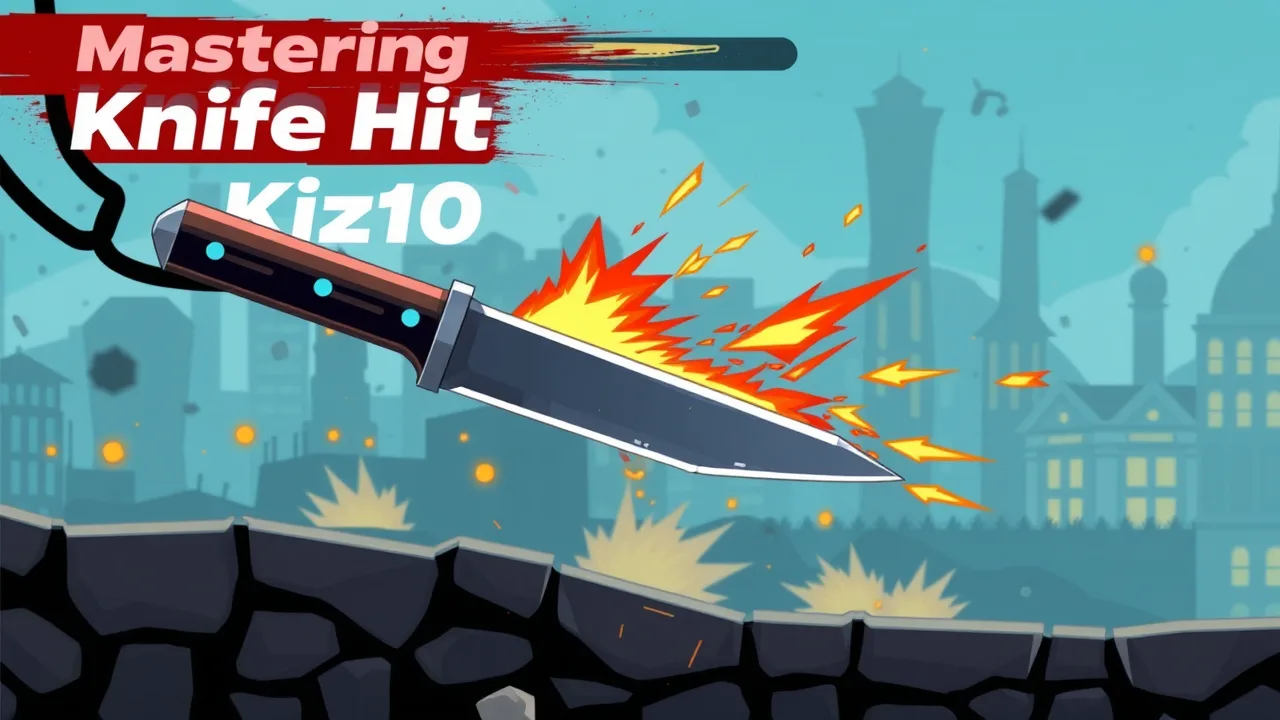
Knife Hit looks straightforward: send a blade into a rotating wooden target without striking a knife that is already there. The difficult part comes after your successful throws begin to crowd the rim. Each blade changes the space available for the next one, so a good opening can become a poor opportunity surprisingly quickly. This guide explains how to watch that changing target, choose useful gaps, and practise with a purpose rather than relying on a rapid series of clicks.
Open Knife Hit on Kizi10 to follow along. The game page uses the Knife Hit name, while the embedded game's opening screen identifies this version as Ultimate Knife Up. That distinction matters: advice about a different knife game may describe features or rewards that do not apply here. The verified opening round has a rotating log, a knife launched from below, existing blades to avoid, and fruit around the target. Begin with those visible elements and let the current screen establish the rest.
Understand what your input actually changes
Your main decision is when to launch. The blade travels towards the target from a fixed position, while rotation brings different sections of the log into its path. Moving a pointer over a particular spot does not turn this into free aiming. Think of the lower edge of the circle as an arrival window: you are waiting for usable wood to pass through that window. A successful throw becomes part of the obstacle pattern, which means the next input needs a new assessment even when the target initially looked almost empty.
Watch a little of the movement before sending your first knife. Pick one visible reference, such as fruit or an embedded handle, and follow its direction around the circle. You are establishing which objects are approaching the launch path and which are moving away. It is easier to interpret a single moving reference than to stare at every decoration simultaneously. Once you understand the direction, shift attention back towards the region where the next knife will arrive. You need a practical picture of the next opening, not a perfect mental map of the whole board.
Read a gap as a moving interval
A clear section of wood is useful only if it remains clear when the launched blade reaches it. This is why throwing as soon as a gap appears can fail. The nearest handle might still be crossing the path, or another blade might be arriving behind it. Look at both boundaries of the opening. The leading obstacle needs time to leave, and the following obstacle limits how long you have. Early in a round, choose generously sized gaps so you can learn that interval without demanding your most precise timing immediately.
There is no need to assign a universal number of milliseconds to the throw. Browser performance, the target's visible movement, and your own response all affect the timing you experience. Instead, calibrate with individual attempts. Launch once, observe where the blade lands, and compare that result with the opening you thought you had chosen. If the landing was nearer the trailing obstacle than expected, allow for that delay on the next attempt. This small observation is more useful than copying an exact click rhythm from an unrelated version of the game.
Why a successful throw should slow your next decision
Success changes the target. The knife you have just placed now occupies a position that was safe a moment ago. Repeating the same input without checking can send the next blade towards your own previous throw. Give yourself enough visual time to see the new handle, identify the neighbouring opening, and decide whether that opening is still comfortable. A deliberate pause is part of playing well. It is especially useful when a good run makes you feel that the next throw should happen immediately to preserve momentum.
Avoid treating the number of knives still waiting as a command to hurry. The remaining supply describes work left to do; it does not tell you whether the current gap is safe. Near the end of a round, the target may contain more obstacles precisely because you have already succeeded several times. Apply more attention to the last few placements instead of less. A patient final throw is preferable to losing the round because its apparent closeness to completion encouraged you to stop reading the board.
Handle fruit without sacrificing the run
The opening round shows fruit near the edge of the wooden circle. That gives you another object to notice, but it should not replace the primary collision check. Before attempting a throw towards fruit, inspect the blades beside it. A tempting target can be a poor choice if its approach leaves little room between knife handles. First establish whether there is a safe landing area. Then decide whether the fruit's position fits the throw you were already prepared to make. This keeps optional opportunities subordinate to staying in control.
Do not assume that every visible fruit counter buys the same upgrades described in guides for other games. Read the menus in this particular version before making decisions about spending or unlocks. For ordinary practice, you can set those systems aside and judge the run by the quality of your placements. Learn to land safely near a visible reference, then learn to leave an awkward reference alone. The second skill matters because recognising an opportunity does not oblige you to take it during that particular pass of the target.
Adjust when the movement becomes difficult to read
Use the motion on the screen as your reference throughout the run. If the movement looks different after a transition, take another observation period rather than carrying over your previous timing automatically. You do not need to predict a fixed sequence of speeds or promise yourself that a certain stage will behave a certain way. Re-establish direction, locate the blades closest to the launch path, and identify one manageable opening. The same process remains useful whenever a new target or unfamiliar arrangement makes the previous rhythm feel unreliable.
When the target feels too busy, narrow your attention. Looking at the entire circle can make every handle appear equally urgent. Concentrate on the area just before the launch path and the nearest obstacle approaching it. Keep peripheral awareness of the rest, but make the immediate decision from the objects that can actually affect the upcoming throw. If you lose track of those objects, wait for a clearer pass. Pressing during uncertainty usually adds another variable to a situation you have not yet understood.
Diagnose misses instead of calling them bad luck
After an unsuccessful attempt, identify the last decision you can describe accurately. Did you throw before the previous blade had cleared? Did you fail to notice your newest knife? Did fruit attract your attention away from a nearby handle? Each cause suggests a different correction. Waiting longer helps with an obstacle that has not left the path, while a fresh scan helps when you forgot a newly placed blade. Merely promising to react faster does not solve either problem and may make premature inputs more frequent.
Another common pattern is making several inputs while the first result is still developing. If that happens, practise a strict single-throw routine: launch, observe the landing, locate the new obstacle, then choose again. You are reducing the number of unfinished events you need to track. Once that routine becomes comfortable, you can make decisions more fluently without deliberately rushing. The aim is not to impose a slow tempo forever. It is to make sure that any faster sequence still consists of separate decisions grounded in the current target.
A short practice plan that produces useful feedback
Give each practice run one objective. On the first, watch direction and make only throws into clearly generous spaces. On the next, pay special attention to the position of your most recently placed knife. On another, choose to ignore fruit whenever the surrounding blades make the route uncomfortable. These are observable habits, so you can tell whether you followed them even if the final score is modest. Changing just one habit also makes it easier to understand why a later run feels more controlled.
Stop briefly if repeated retries make your timing increasingly hurried. A short reset can help you return to observing instead of clicking from frustration. You can also compare this timing challenge with the wider Arcade games collection, which includes different kinds of movement and placement decisions. Choose another game for a change of pace, then return with one specific thing to practise. Improvement in Knife Hit comes from reading the current opening, accounting for your latest blade, and being willing to wait when the next throw is not yet clear.
Questions that help before the next attempt
Should you aim at the centre with the pointer? In the verified opening, the knife launches from below towards the log; timing determines the section of rim it meets. Should you always throw as soon as the previous knife lands? Only if the next opening is actually clear after accounting for that new obstacle. Is collecting every piece of fruit essential to learning? No: safe placement and reliable observation provide a stronger foundation. Use the version in front of you, watch its actual feedback, and build a repeatable decision process before chasing a more ambitious run.