


gem 11 — The complete strategy how to play
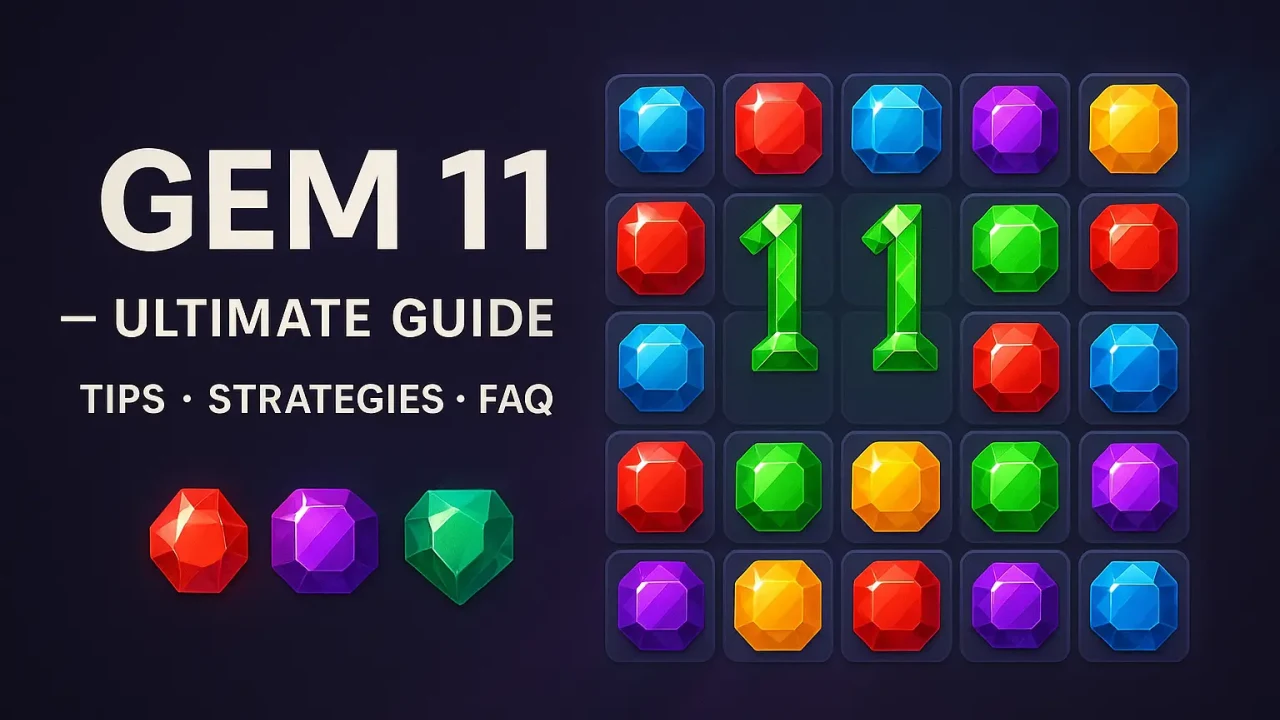
gem 11 is a fast, brain-teasing puzzle where you combine, match, and strategically chain tiles to clear the board and push your score higher and higher. It blends the instant satisfaction of casual match games with the depth of number- and pattern-based strategy: quick to learn, deliciously hard to master. Sessions are bite-sized, yet the “just one more run” itch is real.
The core loop is simple: place or swap pieces, create merges or matches, open space, and set up the next cascade. The magic happens when you plan two or three moves ahead, funneling tiles into high-value combos and clearing big chunks of the grid in a single chain.
TL;DR: gem 11 rewards foresight, board control, and patience. If you love elegant puzzles that punish sloppy moves and celebrate smart chains, you’ll feel right at home.
🎯 Why gem 11 is so addictive
-
Short sessions, long mastery curve: Each round takes minutes, yet refining your approach takes hours.
-
Constant micro-goals: Clear a jam, trigger a combo, rescue a corner, set up a double chain—the board is full of mini objectives.
-
Clean feedback: Every match or merge gives crisp audio/visual cues that reinforce learning.
-
Meaningful risk: Greedy setups can backfire; safe moves might stall progress. Balancing those choices is the hook.
🕹️ How to play gem 11 (step by step)
-
Survey the board: Before you move, scan for immediate matches, potential chains, and trouble spots (tight corners, isolated tiles).
-
Make the safest improvement first: Turn a messy cluster into a future combo by aligning colors/numbers and freeing space.
-
Build for cascades: Don’t only take the obvious single match—aim for positions that will naturally fall into second and third clears.
-
Protect mobility: Keep at least one side of the board spacious so you always have room to maneuver.
-
Cash out wisely: Trigger your “big setup” when the board starts to lock; don’t get so greedy that you run out of legal moves.
⌨️ Controls & interface (desktop and mobile)
-
Desktop: Click to select, click to place/swap; drag for quicker interactions (depending on the game mode). Mouse wheel or on-screen buttons to undo (if available).
-
Mobile: Tap to select, tap to confirm; long-press for special tile info. Swipe gestures may be supported for quick swaps.
-
HUD basics: Score, move meter, upcoming tiles (if preview exists), special power-ups, and a subtle animation hinting at possible matches.
Tip: Turn on subtle audio cues; they help you “feel” rhythm and timing without staring at every tile.
🧠 Scoring, combos, and multipliers
-
Base score: Each clear adds points; larger groups are worth disproportionately more.
-
Combo chains: Clearing again within a short window stacks a combo multiplier. Plan your board so clears happen in quick succession.
-
Special tile values: Wilds, bombs, or multipliers (if present) add situational bonuses—save them for high-impact turns.
-
End-of-round bonus: Many modes reward leftover specials or excess moves with bonus points—don’t forget to factor that into your timing.
💎 Power-ups & special tiles (when available)
While specific names vary by version, you’ll typically see:
-
Wildcard: Matches with any color/number; best used to bridge awkward gaps in a chain.
-
Bomb/Clearer: Wipes a small radius; unjam corners, free center lanes, or interrupt a looming dead-end.
-
Row/Column sweeper: Great for opening corridors and setting up cross-board cascades.
-
Multiplier tile: Place it where multiple clears are likely to happen in sequence.
Rule of thumb: Use power-ups to create opportunities, not just to fix mistakes. If a bomb can both open space and trigger a delayed combo, wait one turn to get double value—provided the board remains safe.
🧭 Beginner strategy: stabilize, then chain
-
Open the center first: A breathable middle makes planning easier than fighting from the edges.
-
Fix asymmetry: Evenly distributed colors/numbers reduce accidental jams.
-
Create intentional funnels: Guide similar tiles toward each other in predictable lanes.
-
Avoid corner traps: Once corners clog, every move gets worse. Keep them tidy.
-
Take the sure thing: Early on, short chains are better than risky five-turn plans.
🦊 Advanced strategy: controlled greed
-
2-turn lookahead: Before committing, preview how the board looks after two moves. If both lines look strong, you’re on track.
-
Edge cycling: Deliberately rotate tiles along the perimeter to feed your center setups.
-
Chain banking: Leave a near-finished match armed and ready; trigger it when you need space or a combo kick-off.
-
Junction theory: A “junction” is a tile that can complete two different matches depending on what it touches next. Cultivate junctions to keep options open.
-
Combo tempo: Combos work like music—downbeat (first clear), upbeat (second), flourish (third+). Learn that rhythm to land multipliers consistently.
⚠️ Common mistakes to avoid
-
Overbuilding a mega-combo: Greed creates dead-ends; if your mobility drops below two safe moves, cash out.
-
Ignoring previews: If the next tile preview exists, plan around it—don’t let it surprise-block a crucial lane.
-
Chasing the wrong corner: If two corners are messy, rescue the one that unlocks the bigger center avenue.
-
Burning power-ups as a reflex: Ask, “Can this open space and trigger a chain one turn later?” If yes, wait.
🏆 Challenge modes & goals
Expect variations like:
-
Score race: Hit a target before you run out of moves.
-
Survival: The board slowly tightens—stay alive as long as possible.
-
Timed rush: Fast combos beat slow perfection; tempo is everything.
-
Puzzle packs: Pre-built boards with a single clean solution—great for learning exact mechanics.
Each mode emphasizes different skills—rotate among them to become a rounded player.
📚 What genre does gem 11 belong to?
gem 11 sits at the intersection of casual puzzlers and match-style games. If you’re curious about the broader genre conventions, the match-three family is a good frame of reference—mechanics like adjacency, cascades, and power-up clears are shared across many titles. You can read a general overview here: match-three (Wikipedia).
⚙️ Performance, accessibility, and QoL tips
-
Animations: If your device is older, reduce animation intensity to keep inputs snappy.
-
Color-blind aids: If available, enable shape or number overlays to complement color signals.
-
Input comfort: On mobile, increase touch tolerance; on desktop, enable hover hints if you tend to misclick.
-
Sound mix: Lower music, keep effects slightly higher—the sfx help you time chains.
🔁 Daily habits that improve fast
-
Warm-up runs: Do two quick boards focusing only on clean shape formation.
-
One skill per session: “Today I practice junctions.” Singular focus accelerates learning.
-
Review a blunder: After a failed run, locate the first bad decision, not the last.
-
Set a micro-goal: “Trigger three 3x combos,” instead of “beat my high score.”
🧲 Similar experiences (for skill transfer)
Working knowledge from tile-matching, number-merging, and path-planning puzzles translates well. If you’ve played grid-based strategy games, the instincts for space management and threat priority carry straight into gem 11.
🚀 Ready to play?
If you’re itching to put these ideas into action, jump into a round and practice the basics, then layer in advanced techniques as you go. Here’s the single requested backlink: Play gem 11 on Kizi10.
Pro tips cheat-sheet (quick reference)
-
Keep the center open, clean corners sparingly.
-
Build junctions that can complete multiple matches.
-
Bank a ready combo and cash out when space shrinks.
-
Treat power-ups as opportunity creators, not panic buttons.
-
Aim for tempo: three clears in quick succession beat one big nuke.
🧑🏫 How to master gem 11 faster (structured plan)
Week 1: Fundamentals
-
Sessions: 15 minutes/day
-
Focus: Recognizing safe vs. greedy moves, opening the center, clearing jams.
-
Goal: End runs with at least one power-up unused (discipline over impulse).
Week 2: Combos & junctions
-
Sessions: 20 minutes/day
-
Focus: Setting up two-turn chains; keeping one junction active at all times.
-
Goal: Trigger at least one 3x combo in half your games.
Week 3: Efficiency & tempo
-
Sessions: 20–30 minutes/day
-
Focus: Fewer inputs per clear, deliberate chain timing.
-
Goal: Increase average combo length by 0.5 (track a 10-game rolling average).
🧩 Frequently Asked Questions (10 detailed Q&As)
1) ❓ What’s the single most important skill in gem 11?
Answer: Board mobility. Players often obsess over massive chains, but the foundation is keeping 2–3 safe options available at all times. As long as you can reposition tiles without clogging corners, scoring opportunities naturally appear. Practice “space checks” every turn: if you’re about to reduce your options to one, reconsider and open space first.
2) ❓ How do I create consistent combo chains?
Answer: Build staged matches. Arrange the board so one clear causes gravity/adjacency to align the next. This means pre-aligning tiles one step away from completion—think “almost matches” waiting in line. Keep a mental queue: after Match A, what snaps into place to become Match B?
3) ❓ When should I use bombs or sweepers?
Answer: Use them when they both (a) free a key lane or corner and (b) lead to a follow-up clear within one or two moves. If you can’t get both, wait a turn. Power-ups used solely to fix a mistake are worth less than those that open space and start a combo.
4) ❓ I keep getting stuck near the end—what am I doing wrong?
Answer: Usually it’s over-investment in a single mega-setup. As the board tightens, switch from greedy play to cash-out mode: trigger your banked chain, clear space, then rebuild. If you don’t have a banked chain, you waited too long—start seeding junctions earlier in the run.
5) ❓ What’s a practical two-turn lookahead?
Answer: Imagine you make Move 1—visualize the new board, then pick your best Move 2 from that position. If both Move 1 and Move 2 look strong (open space, create a near-match, or trigger a chain), proceed. If Move 2 is forced or ugly, try a different Move 1.
6) ❓ How can I practice without caring about score?
Answer: Play constraint drills. For 10 moves, forbid yourself from touching corners; for the next 10, only interact with the middle 3×3 (or equivalent). These drills isolate skills: lane creation, central mobility, and delayed gratification. Afterwards, return to normal play—your reads will feel sharper.
7) ❓ Are there beginner-friendly openings?
Answer: Yes—Center First (open middle lanes), Mirror Sweep (balance left/right clears to keep symmetry), and Staggered Build (create two nearly-complete matches in separate zones, then link them). Rotate these openings to discover which fits your style and the RNG of upcoming tiles.
8) ❓ How do I recover from a bad board?
Answer: Identify the primary choke (the tightest area that prevents flow). Spend 2–3 moves doing nothing but opening that choke—use a bomb if you must. Once air returns to the board, re-establish a junction and a banked chain. Don’t chase score while suffocating; space first, points second.
9) ❓ Any settings I should tweak?
Answer: If options exist, enable tile previews and subtle hints (not auto-moves). Reduce heavy animations if inputs feel sticky. On mobile, widen touch areas. Keep effects sounds slightly louder than music—they’re valuable timing cues for cascades.
10) ❓ What’s a good progression plan from casual to competitive?
Answer:
-
Casual: Learn jam prevention, trigger basic 2x combos.
-
Intermediate: Maintain one junction and one banked chain at all times.
-
Advanced: Orchestrate 3x+ chains while protecting mobility. Record your runs, review the first mistake, and adjust openings based on board RNG.
📌 SEO snapshot (for snippets & meta)
-
Primary keyword: gem 11
-
Search intent covered: what it is, how to play, tips, strategies, features, controls, FAQs.
-
Content focus: action-oriented, jargon-light, with practical drills and a big FAQ.
Final take
gem 11 shines because it respects your time and your brain. The rules are approachable, but the ceiling is high; the better you plan, the more the board rewards you. Keep the center open, cultivate junctions, bank a combo, and strike when the space gets tight. That loop—prepare, survive, unleash—never gets old.