Representative games and differences
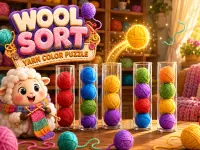
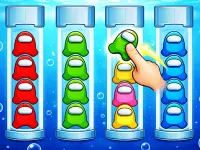
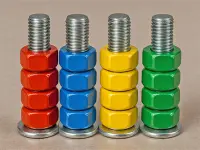
Water Sort Puzzle Color Sorting Game uses tubes and colored liquid. Water Color Sorting follows the same broad liquid family. Color Ring Sorting Match uses movable rings rather than pours, while Wool Sort Yarn Color Puzzle groups strands. Nuts Color Sorting Game applies sorting to hardware, and Kitchen Sorting changes both the objects and presentation. Check whether the game moves one object, one connected color group, or an entire layer.
How liquid sorting is planned
A tube generally accepts a pour when it is empty or shows the same color on top and has enough capacity. Only the exposed connected layer moves. Build complete colors when the remaining copies are reachable, and keep a buffer tube open for blockers. A legal match can still be a poor move if it fills the last flexible container.
Advice for other sorters
For rings, yarn, or objects, look for the equivalent of an empty tube: a post, slot, or tray that can temporarily hold a piece. Consolidate obvious matches when doing so opens space. If the board becomes crowded, find a reversible matching move that empties one location rather than moving random blockers.
The internal color sorting guide explains buffers, short move cycles, and recovery from a locked layout.
Accessibility and device tips
Similar shades can be difficult to distinguish on a small display. Enlarge the play area when available and compare position as well as hue. Use one deliberate tap for the source and one for the destination; rapid tapping can select the wrong container.
Questions
Are all top-color matches good? No; consider capacity and buried layers. Why keep an empty space? It exposes blocked colors and enables reversals. What is the objective? Usually to leave each active container with one color, though match variants may define a different finish.
How difficulty grows
Early levels often provide several empty locations and obvious pairs. Later boards use more colors, fewer buffers, deeper blockers, or shades that are visually close. The underlying rule may remain simple while the order of operations becomes demanding. Count capacity before moving and avoid using every open place for a different temporary color.
A completed group should simplify the puzzle. If finishing one stack traps several unmatched pieces, the completion happened too early. Keep partial groups accessible until you know where the remaining copies are. In object sorters, the same idea applies to posts, trays, or boxes.
A repeatable solving checklist
First identify legal matches that empty a location. Second, choose likely final homes based on matching lower layers. Third, reserve one buffer for the color currently blocking progress. Fourth, execute a short cycle and reassess. Do not plan ten moves on incomplete information when two or three moves will reveal a new layer.
If undo is available, use it to test a specific branch rather than tapping at random. If restart is the only option, remember the first point where the board lost flexibility. Replaying the sound opening quickly and changing that decision is more efficient than inventing an entirely new sequence.
Players can also compare solutions by counting moves, but a low move total is meaningful only after the puzzle is understood. First build a reliable solution that preserves space. Then remove transfers that merely shuttle the same blocker back and forth without exposing a color or completing a group.